How to implement SEO
Creating an exceptional website lays the foundation for a successful SEO strategy. Your website should not only be visually appealing but also highly functional, offering a seamless user experience while delivering essential information effectively. This is fundamental to providing valuable solutions for users’ search queries.
Yet, SEO goes beyond just website design. To initiate your SEO journey and align with Google’s best practices for ranking, prioritize the following actionable steps:
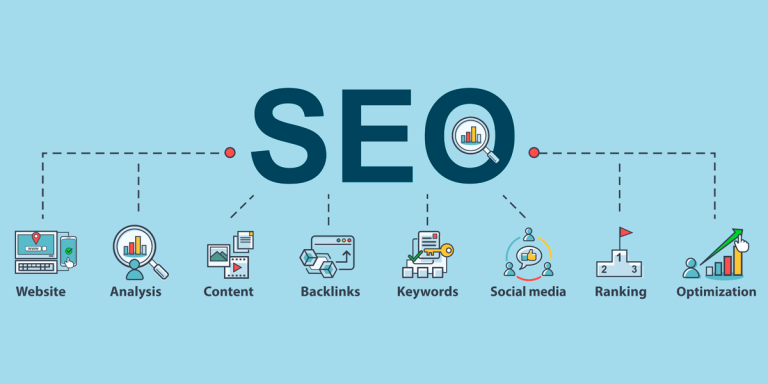
Effective search engine optimization demands consistent effort, underscoring the importance of a well-considered strategy before delving into the specifics. Align your SEO plan with your broader objectives to assess its success. Whether you’re an eCommerce site seeking to boost traffic and sales or aiming to enhance brand awareness for a brick-and-mortar store, keep your goals in mind from the outset and optimize your website accordingly.
Delve into particulars such as your site’s URL and consider larger factors like staffing for SEO – whether you’ll have dedicated personnel or handle optimization alone. Plan your approach for monitoring SEO performance and optimization right from the start. Define your criteria for success and how you’ll track rankings.
If you’re uncertain about the best optimization routes, experiment with one while keeping alternatives on standby for future use. Remember that SEO success is a gradual process, so exercise patience and maintain consistency in your efforts.
Undoubtedly, one of the most critical aspects of grasping and implementing SEO lies in conducting comprehensive keyword research. Keyword research involves the systematic exploration of the most relevant words to incorporate into your webpages. By delving into this investigative process, supported by professional keyword research tools, you gain insights into how people globally tend to search for products or services related to your brand.
Keyword research serves as the compass guiding your SEO efforts. It aids in identifying highly sought-after phrases, thereby shaping the creation of pages that can be meticulously optimized for those specific queries. The choice of words on your webpages wields a profound impact on the volume of traffic your site attracts.
Our recommendation is to brainstorm a range of topics intimately related to your brand, leveraging them as focal points for keyword research and content creation. In recent years, Google has evolved to comprehend that, beyond singular keywords, pages can offer comprehensive solutions to overarching topics. Instead of fixating solely on a single keyword to underpin your SEO strategy, contemplate a broader spectrum of keywords your page could rank for within a given topic. You may still designate a primary keyword for your page title or URL, but emphasize your pages as authoritative sources offering comprehensive information on the topic.
Let’s consider an example. If you’re “Jenny” and you operate a flower shop, it might be tempting to optimize your homepage exclusively for the keyword “flower shop.” While this is a valid choice, it shouldn’t be your sole focus. Think about the diverse aspects related to the flowers you offer, such as flower delivery, flower freshness, or various flower types. Incorporating content about these topics transforms your site into a valuable resource for those seeking to purchase flowers. By enriching the user experience, you simultaneously convey to Google that your pages are prominent contenders for anyone searching for a complete flower solution.
However, keyword research doesn’t culminate there. Continuing with the flower shop example, you may observe that the search results for “flower shop” are dominated by renowned brands, surpassing the reach of your small store. In such cases, you may want to pivot towards your geographical location (local SEO) or emphasize a particular niche using long-tail keywords. By integrating this information into your webpages, you communicate to Google that your business is a robust option for individuals seeking precisely what you specialize in.
Swift website loading is a critical factor in Google’s ranking algorithm. The speed at which your website loads is not just about user experience but also influences how well your site fares in search results. A slow-loading site can deter visitors before they even get a chance to see your content. Therefore, optimizing your website’s loading speed is a top priority for SEO success.
Google prioritizes three core web vitals when it comes to loading times:
- Largest Contentful Paint (LCP): This metric measures the time it takes for a user to see the most significant content on a webpage after clicking a URL. Google rewards websites that deliver primary content promptly.
- First Input Delay (FID): FID calculates the time between a user clicking a URL and being able to interact with page elements. A quick FID ensures that users can engage with your site seamlessly.
- Cumulative Layout Shift (CLS): CLS assesses the stability of page elements as a page loads. A low CLS score indicates that page elements remain relatively steady during loading, leading to a smoother user experience.
To boost your Google ranking and improve loading times, follow these key optimization strategies:
- Avoid overwhelming your site with excessive media or complex features, simplifying your site’s design.
- Optimize image sizes by properly compressing and formatting them.
- Stick to one or two fonts for a cleaner, more professional appearance.
- Minimize elements that can disrupt the page layout, ensuring a more stable loading experience.
By implementing these practices, you not only accelerate your website’s loading speed but also enhance user experience, contributing to improved Google rankings and better SEO performance.
Metadata plays a vital role in conveying information to Google about the content of your webpage. Key elements of metadata encompass title tags and meta descriptions. When users conduct searches on a search engine, the results are presented with a headline and description, providing an overview of the page’s content. Furnishing Google with this information benefits both searchers and Google, helping them understand the core aspects of your pages.
Many SEO experts regard meta titles (title tags) and meta descriptions as some of the most potent SEO signals to communicate with Google. It is, therefore, imperative to incorporate your primary keywords in your title tags.
Title tags and meta descriptions offer an additional SEO advantage. They grant you control over the text users encounter when they first encounter your website in search results. Including compelling text that directly addresses the searcher’s query can result in more clicks to your site. The higher the click-through rate, the more Google perceives your site as a suitable match for users’ queries, potentially leading to improved rankings.
It’s crucial to acknowledge that while you provide metadata, Google doesn’t commit to using it verbatim. Google retains the discretion to alter your headlines or descriptions as they deem appropriate. In recent times, there’s a shift toward Google not consistently utilizing provided title tags and meta descriptions. Nevertheless, the titles and descriptions you craft for your pages still hold the potential for usage on search engine result pages (SERPs) and are worth optimizing to enhance your SEO performance.
Alt text, also known as alternative text, serves as a concise description provided for images on your website. Embedded within your site’s HTML, it holds significant value in the realm of SEO. Web-crawling bots swiftly interpret alt text to comprehend the image’s content.
Alt text is more than an SEO asset; it’s a crucial accessibility feature that ensures a comprehensive understanding of your webpages for blind users who rely on screen readers. These tools audibly convey the alt text, offering a detailed depiction of images to users who cannot visually perceive them.
This descriptive alternative text also enhances the likelihood of your images appearing in Google searches, not only in the Google Images section but increasingly at the top of standard search result pages. Images are now a standard part of Google searches, and well-crafted alt text increases the chances of your images ranking. When your site gains visibility through both image and content ranking, it can attract more traffic. Google also views websites that employ alt text as more comprehensively optimized, positively impacting their search engine standing.
One key consideration is how to craft alt text effectively. While observing an image, you can envision various ways to describe it. For SEO purposes, strategic thinking about your alt text is recommended, including the incorporation of relevant keywords to enhance your site’s search engine performance. However, it’s crucial to strike a balance; alt text should not be solely keyword-focused but should genuinely and accurately explain the image’s content. This approach ensures an optimal blend of SEO effectiveness and accessibility.
Links play a pivotal role in SEO, serving as a fundamental element in how Google understands and organizes your website’s content. When one page links to another, it aids Google in navigating your site and establishing connections between pages and their content. This not only assists in categorizing pages but, more importantly, streamlines the process of indexing your pages, making them more accessible in search results.
One of the most effective linking strategies is internal linking, which involves creating links between pages within your own website. This approach is straightforward as you have full control over all your pages and can seamlessly incorporate links from one to another. Internal linking is a potent tool for boosting your site’s authority. By linking less-visited pages to more authoritative ones within your site, you send a signal to Google that both pages hold significance.
Internal linking also holds considerable value for user experience. By connecting relevant pages, you enhance your website’s navigational structure, making it easier for users to locate the information they seek. This strategic internal linking can facilitate traffic flow between your website’s pages, drawing attention to all your digital assets and creating a more user-friendly and well-organized online environment.
External links, commonly known as backlinks, occur when other websites link to your site. This represents a crucial SEO strategy as it elevates your site’s authority. When a reputable webpage references your content, it sends a powerful signal to Google, signifying that your pages offer valuable information. External links not only enhance your site’s credibility but also expand its reach, enabling more potential users to discover and engage with your products or services.
The effectiveness of external links is most pronounced when they occur naturally and organically. This transpires when another platform recognizes your value and deems your site as a valuable resource for their audience. Consequently, they link to your page to enhance the experience of their readers or users. The more authoritative or influential the linking site, the more valuable their endorsement becomes. While there are no shortcuts to obtaining genuine external links, the most effective approach is to consistently produce high-quality content that naturally attracts attention and referrals from other websites. This commitment to quality content creation remains the most dependable method for building a network of reputable backlinks.
In the realm of SEO, it’s imperative to ensure that your website is accessible to all users and offers a positive experience. With over 50% of today’s internet traffic originating from mobile devices, it’s not only a wise business move but also a priority for Google to have a mobile-friendly website.
Ensuring your website is mobile-friendly not only expands your business reach and caters to users on mobile devices but also aligns with Google’s approach. The search engine frequently employs mobile-first indexing, a practice where it primarily crawls the mobile version of your site to determine its ranking in search results. This underscores the importance of your site’s mobile version.
When you create a site using Wix, a mobile version is automatically generated for you. You can access this version by toggling to the mobile icon in the editor. We recommend thoroughly reviewing this mobile version to verify that it aligns with your vision and that all site elements are easily accessible. Pay particular attention to mobile navigation, ensuring that your site menu and buttons are clear and user-friendly. An optimized mobile experience not only caters to the majority of internet users but also contributes positively to your site’s SEO performance.
As SEO is a dynamic and ongoing task, it’s crucial to regularly evaluate your pages’ performance and make necessary adjustments. You can monitor your page rankings and performance using SEO tools such as Ahrefs and Google Search Console to gauge the direct impact of your optimization efforts. These tools offer insights into improvements in your rankings and highlight keywords for which your site is performing well. If you’re dissatisfied with your rankings or traffic, you can revisit the strategies mentioned earlier in this list and fine-tune your content accordingly.
Additionally, valuable analytics tools like Google Analytics and Wix Analytics are indispensable. These tools provide deeper insights into your website’s traffic sources and user behavior. They allow you to understand how users interact with your pages, offering crucial data to optimize your content effectively.
By consistently monitoring your site’s performance and using these analytics tools, you can adapt to changing SEO landscapes and ensure that your website remains competitive and effective in reaching your target audience.